

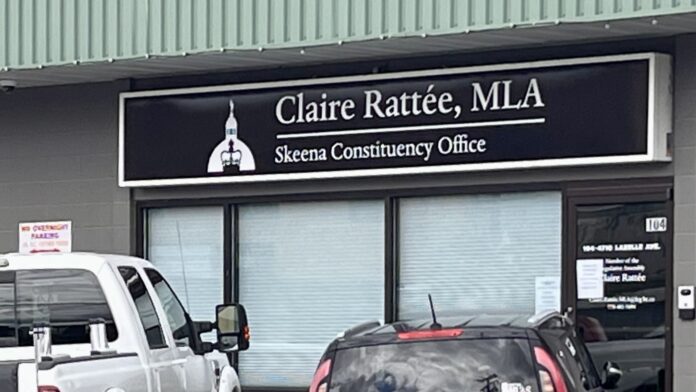

Skeena MLA Claire Rattée is calling on the provincial government to take action to improve the reliability of telecommunications services in Northwest B.C., citing a series of recent outages that occurred in the area in August.
Rattée’s call comes after a major telecommunications outage on Aug. 2, reportedly caused by copper cable theft, followed by another widespread internet outage on Aug. 11. CityWest said its Aug. 11 outage was caused by damage to a third-party carrier’s fibre network and affected customers across a large portion of northern B.C.
In a letter sent to Minister of Citizens’ Services Diana Gibson, Rattée expressed her concerns regarding the recent outages and the current vulnerability of communications infrastructure in Northwest B.C.
Rattée said the Aug. 2 outage showed how vulnerable the region’s telecommunications system really is.
“When these outages happen, the consequences go far beyond inconvenience,” Rattée said in a statement. “Residents can lose access to emergency information, businesses can’t process transactions, families can’t communicate, and entire communities can be left without reliable access to essential services.”
Rattée also highlighted that the issue had been brought up in her office to both TELUS and the provincial government following a major telecommunications outage in May. That outage affected communities across the Northwest after fibre lines were damaged during an attempted copper cable theft.
During the issue, Rattée stated that her office questioned what the plans were to increase connectivity in Northwest B.C., what the backup solutions were in case of failure of the fibre line, and what actions were that were being taken to stop further disruptions like this one in the future.
According to Rattée, months later those concerns remain unresolved.
Rattée argued that communities across Northwest B.C. continue to rely heavily on limited telecommunications infrastructure, leaving them vulnerable to a range of threats including cable theft, wildfires, severe weather, infrastructure failures and other emergencies.
She continued, saying that connectivity had become a necessary service for communication, getting information during emergencies and accessing government services.
“When telecommunications infrastructure fails in Northwest B.C., thousands of British Columbians are impacted,” Rattée wrote. “People were unable to purchase gas or groceries, businesses lost revenues, and, ultimately, residents’ safety was put at risk.”
The recurring incidents are particularly concerning, Rattée said, arguing that threats to telecommunications infrastructure should no longer be viewed as isolated incidents.
At the same time, she pointed to the growing risk posed by wildfires and other emergencies that could damage communications infrastructure.
“Whether the cause is copper cable theft, wildfire activity, severe weather, infrastructure failure, or another unforeseen event, the result is the same: entire communities can be effectively cut off from the rest of the province with little warning and limited alternatives,” Rattée wrote.
Rattée is now seeking details from the province on what measures are currently in place to provide redundancy should a primary telecommunications corridor serving Northwest B.C. be disrupted.
She is also asking whether additional fibre routes, secondary network connections or other infrastructure investments are being considered to reduce reliance on a single point of failure.
There are already plans for another fibre route in the region. Following the recent outages, CityWest is advancing a new transport route along Highway 37 that would create an additional pathway into Northern B.C.
Once completed, the route is expected to strengthen network resiliency by providing another option for moving telecommunications traffic if an existing route is disrupted.
The letter also asks how the province plans to keep communities connected during emergencies and work with telecom providers to improve service reliability.
“Our region cannot continue to depend on a single fibre optic line as the primary means of remaining connected,” Rattée wrote.
“The people of Northwest British Columbia deserve the same level of connectivity reliability as residents elsewhere in the province.”
The Ministry of Citizens’ Services has not yet publicly responded to Rattée’s letter.