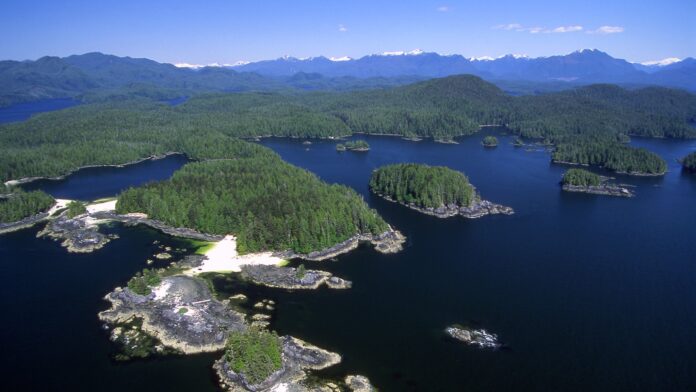

The Haida Nation is celebrating a major victory after British Columbia’s top court ruled the First Nation has sovereignty over Haida Gwaii.
The Haida called the decision historic, noting in a statement it’s the first time the B.C. Supreme Court has issued a declaration of Aboriginal title which encompasses the entire terrestrial portion of an Indigenous nation’s territory.
“Haawa to our ancestors and all those who came before us to help lead to achieving this long-awaited declaration of title to the land of Haida Gwaii,” said Gaagwiis, President of the Haida Nation, in a statement.
The First Nation’s application was supported by the federal and provincial governments.
The order includes an agreement that the Haida Nation, B.C. and Canada will reconcile their respective laws, jurisdictions, and titles during a transition period.
The decision marks the end of a major part of the Haida Nation’s ongoing court case over title to Haida Gwaii, initially filed more than two decades ago.
But the B.C. Conservatives are raising concerns about what the ruling means for private property in Haida Gwaii.
Leader John Rustad said the decision comes after years of negotiations carried out by the NDP government without transparency or public input.
“The Eby NDP has allowed this process to unfold in secrecy, without consultation with non-Indigenous residents or businesses, and now thousands of British Columbians face uncertainty over their homes, property, and livelihoods,” said Rustad in a statement Tuesday.
The Haida said the agreements and the court order follow five years of negotiations to reconcile Haida title with the interests of non-Haida residents of Haida Gwaii.
The Haida Nation, the province and Canada came to an agreement on a framework for reconciliation in 2021.
That was followed in 2023 by an out-of-court agreement recognizing the Haida Nation as the holder of Haida Title and Rights and the Council of the Haida Nation as the governing body of the Haida Nation.
An agreement on the next phase of Aboriginal title implementation was signed in spring 2024, along with supporting legislation.
The province said it consulted with local governments and businesses, industry and tourism operators, residents and property owners in the lead up to that agreement. Community meetings open to all residents of Haida Gwaii were held in March and April 2024 in four communities.
“Private property rights are the foundation of a free society and a strong economy,” said Scott McInnis, MLA for Columbia River-Revelstoke and Conservative critic for Indigenous relations and reconciliation. “By throwing those rights into the garbage, the Eby government has created enormous legal and economic uncertainty – not just for Haida Gwaii, but for all of British Columbia.”
But Spencer Chandra Herbert, Minister of Indigenous Relations and Reconciliation is pushing back against claims that this agreement casts uncertainty onto property rights.
“The order says in many places, that this agreement will have no impact on private property,” said Chandra Herbert in a statement to Vista News. “When we can negotiate a good deal with Nations, rather than through litigation – we provide certainty and reassurance for everyone for the long term.”
“And the leader of the opposition knows this, because during first reading he stood up in the Legislature and praised the agreement with the Haida Nation. That kind of politics we are seeing from the opposition is designed to pit neighbour against neighbour and it’s just plain wrong,” said Chandra Herbert.
Concerns over fee simple property rights have been front and centre since the B.C. Supreme Court’s finding on Aug. 7 that the Cowichan Tribes (Cowichan) hold Aboriginal title to a portion of their lands in Richmond. The province has said it will appeal the ruling.
“This ruling could have significant unintended consequences for fee simple private property rights in B.C. that must be reconsidered by a higher court,” said B.C. Attorney General Niki Sharma following the decision.
The federal and provincial governments opposed the claim, as well as Richmond, the Vancouver Fraser Port Authority, Tsawwassen First Nation, and the Musqueam Indian Band.